

docinflow
All five
R2RLedger, GST and audit trail

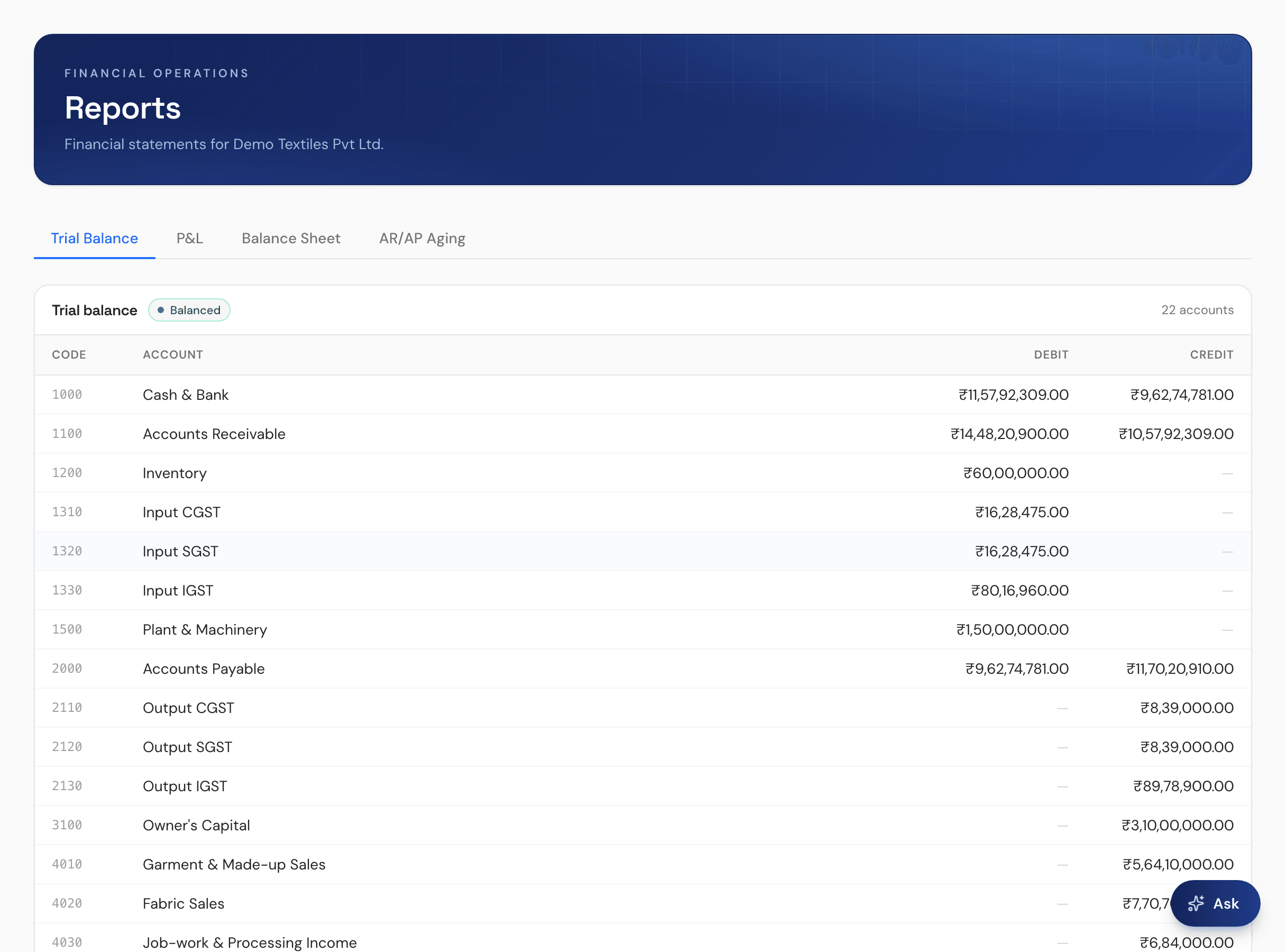
Trial balance, P&L and balance sheet, live from the ledger.

Debits must equal credits before anything posts, so the statements tie out by construction. GSTR-1, GSTR-3B and HSN summaries carry invoice-level detail and fold credit notes into both returns.

What it does

Built to produce a verdict, not a to-do list.

A real double-entry ledger, not a reporting layer.

  • Trial balance, profit and loss and balance sheet derived live from the ledger, with debits-equal-credits enforced before anything posts
  • GSTR-1, GSTR-3B and HSN summaries with invoice-level detail, the consumer split, and credit notes folded into both returns
  • Append-only history naming who created, approved, edited or voided every record, with the values before and after
app.docinflow.ai
DocInflow Accounting
Accounting in DocInflow

What it actually does, step by step.

Each stage below is a real part of the product, not a category. The counts come from the configuration the product ships with.

5
ways a journal entry is refused before it can be written
6
dedicated GST accounts, split input and output
9
states a finance document moves through
1

Post through one engine

  • Every invoice, bill, note, payment and manual journal goes through one function
  • Five separate refusals, including debits not equalling credits
  • Money is stored at two decimals and quantities at six — never as floating point
  • A correction is a mirror entry, so a historical trial balance stays reproducible
2

Keep tax in its own accounts

  • Six dedicated GST accounts — input as assets, output as liabilities
  • A generic tax account is used only when a document carries no split
  • Fifteen accounts seeded; fourteen protected from edits that would break posting
  • An account with even one journal line against it cannot be deleted
3

Read the statements off the postings

  • Trial balance, profit and loss and balance sheet from one aggregate
  • The trial balance returns a balanced flag; the balance sheet checks itself
  • Current-period net income is derived, so no year-end entry is needed to balance
  • A day book, a party ledger and a running-balance statement of account
4

File GST from what posted

  • Outward supplies split business-to-business, and consumer large and small
  • The large split is tested per invoice, not against a customer's monthly total
  • Credit notes are tabled separately and netted off the headline
  • An HSN summary that prefers the line's own code over the catalogue's
5

Reconcile the bank

  • A book balance, a reconciled balance, and a difference that is the unmatched net
  • Tick many lines in one call; repeating a match is a no-op
  • Un-reconciling deletes the link and writes its own audit row
  • Cash flow totals come off the cash lines themselves, so they are exact
6

Value the stock, and know who did what

  • On-hand is never stored — it is folded from an append-only movement ledger
  • Approving a bill posts stock in; approving an invoice posts it out
  • Weighted-average cost drives valuation and the low-stock list
  • An append-only log over nineteen fields, recording actor, reason and both values

Scroll sideways for the rest of the flow.

A number nobody can trace is a number nobody can defend.

When a figure has already gone to a bank or a board, the question is not what it says but who moved it, and from what.

Core capabilities

Strengthen your books end to end

TRIAL BALANCECash and bank38,41,220Accounts receivable1,24,90,180Accounts payable84,16,400Revenue1,20,41,000Agrees2,24,31,4002,24,31,400

A ledger that cannot go out of balance

Every invoice, bill, credit note, payment and manual journal goes through the same function, and it validates before it writes: no lines, a negative amount, a line carrying both sides, a line carrying neither, and debits not equalling credits are five separate rejections.

  • └─An unbalanced entry cannot reach the ledger to be found later
  • └─Money is stored at two decimals and quantities at six, never as floating point
  • └─A correction is a mirror entry, so last quarter's trial balance still reproduces
OUTWARD SUPPLIESBusiness to business142ReadyConsumer · large8ReadyConsumer · small61ReadyCredit notes6Netted

GST returns that reconcile before you file them

Six dedicated accounts keep input and output tax apart. Outward supplies split business-to-business and consumer large and small — and the large test runs per invoice against the threshold, not against a customer's monthly total, which could never answer whether any single invoice crossed it.

  • └─Credit notes are tabled separately and netted off the headline
  • └─The return reconciles with the summary instead of diverging by the note amount
  • └─An HSN summary prefers the line's own code over the catalogue's
RECONCILIATIONBook balance38,41,220Reconciled36,02,880Unmatched lines7Difference2,38,340

Every rupee of difference, explained

Reconciliation returns a book balance, a reconciled balance and the difference between them — which is, by construction, exactly the net of the lines still to be matched. Ticking many lines is one call, and repeating a match does nothing.

  • └─The difference is explainable rather than investigated
  • └─Un-reconciling deletes the link and writes its own audit row
  • └─Cash flow totals come off the cash lines themselves, so they are exact
DOCUMENT HISTORYEdited · total11 AugR. IyerApproved09 AugS. NairSubmitted09 AugA. RaoCreated08 AugA. Rao

Every number traces back to a person

An append-only log spans documents, journal entries and reconciliations under eleven actions, recording the actor, their address, a reason and a before-and-after pair reduced to only the fields that changed out of nineteen tracked.

  • └─A document with a payment applied cannot be voided at all
  • └─Neither can one sitting mid-approval, which would strand the pending steps
  • └─The trail reads as names, not as identifiers
How the check works

The documents, and what is compared between them.

DEBITCREDITBalanced — 22 accounts
What changes

The difference is where the check happens.

Typical practice

Operational documents live in one system and the books in another, so the ledger learns about the business weeks late.

With DocInflow

Approved documents post as they happen, and the statements are a live read of the ledger rather than a month-end assembly job.

Typical practice

Someone edits a figure that was already shared with a bank or a board, and nobody knows who moved it or what it was before.

With DocInflow

Every posting, edit, approval and void carries a name, a time and the value before it changed — on a history that is never overwritten.

Not built yet — said plainly
  • A period close and lock that refuses a posting into an already-reported month
  • Importing a bank statement to reconcile against, rather than against the ledger itself
  • Reverse charge, input-credit eligibility and export or SEZ classification in tax reporting

We publish what is not built yet because you will find it in the first ten minutes of a trial anyway — and because a vendor who tells you the boundary is the one worth believing about everything inside it.

The rest of the platform

It is one system underneath.

Same document layer, same control model, same audit trail — which is why a price agreed in a contract can be checked on an invoice and land in the ledger without leaving the product.

Run it on your own documents.

A pilot runs on your paperwork, not a sample file. Send a real set — a purchase order with its invoice, or a letter of credit with its proforma invoice — and we will run the checks on it.